The Value of Green Jobs
Damian Whittard is an Associate Professor in Economics at the University of West England. His research will generate and test alternative measures of green jobs, applying these to better understand the earnings and career prospects of those working in them in England and Wales.
Publications

Information
This Data Explained summarises experiences and learning from working with the Annual Survey of Hours and Earnings and Census 2011 linked dataset, which was linked to O*NET (Occupational Information Network) datasets to study green jobs in England and Wales. This publication is intended to help guide future researchers using this data and to provide feedback into future dataset development and documentation

Abstract
Abstract: Given the urgency of the transition to net-zero, there is a need for a robust evidence base to support an environmentally sustainable and equitable economy. Employing a linked administrative dataset and using both cross sectional and panel estimation techniques, this study examines employment opportunities and estimates the economic benefits of working in green occupations. Consistent with social role theory, the results indicate that individuals are more likely to work in green occupations if they are white, male, full-time, not represented by a collective agreement, and work for an SME or foreign owned business.
Contributing to the international literature on pay in green jobs, the study reports a pay premium of four percent after controlling for other factors. Employees covered by collective agreements receive additional pay benefits, yet representation is less prevalent in directly green occupations. In line with research into attitude-behaviour gaps, the study demonstrates that while personal travel behaviours and green employment choices are often inconsistent, when they align this yields a pay dividend.
The research makes an important and novel contribution by showing that green employment can partially mitigate inter-occupation pay gaps, while identifying that persistent gender and ethnic pay disparities remain within green occupations. Females appear particularly disadvantaged by domestic and childcare responsibilities. This study also reports sector effects, with more traditional industries such as manufacturing and construction exhibiting entrenched gender biases. The results highlight the need to integrate considerations of inequality into theoretical frameworks that aim to understand and conceptualise the uptake of green jobs.
Presentations
Damian will be presenting his work at this year’s Pint of Science Festival, where he will join other researchers from across multiple disciplines to discuss ideas concerning some of the biggest issues of the day… with a pint!
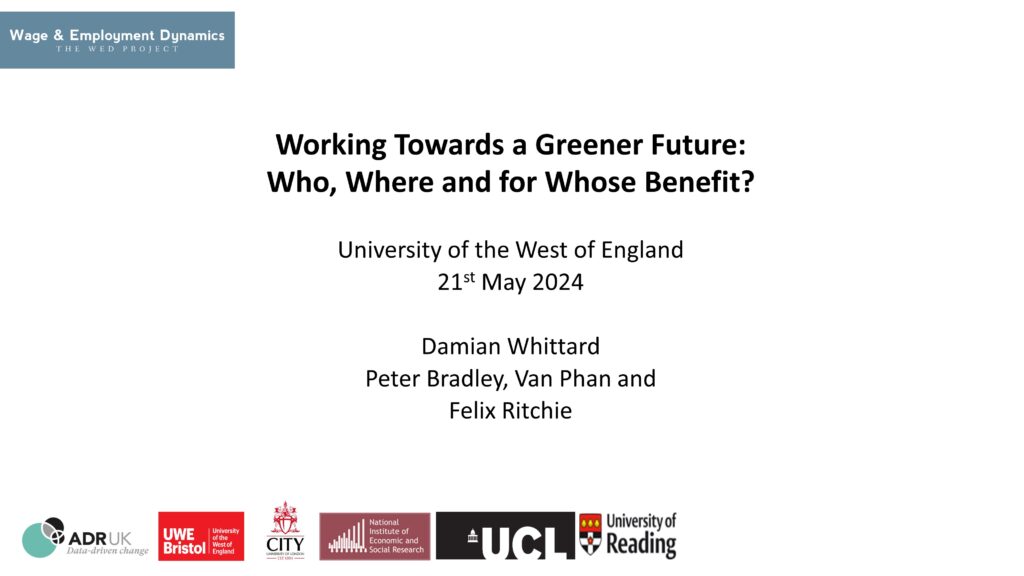
Damian presented the findings from this project at both the Economic Statistics Centre of Excellence (ESCoE) Conference, and at the ADR UK/ONS Research Innovation Workshop. You can find this presentation here.

Damian presented his work, in which he is using the ASHE-Census 2011 dataset to explore the value of green jobs, at the Research Symposium held by the WED team in November 2023. You can watch his presentation here.

This video provides some excellent insight into Damian’s Green Jobs project. You can watch it here.